AI-rony
“It ain’t what you don’t know that gets you into trouble. It’s what you know for sure that just ain’t so. “ – Mark Twain

AI-rony
“It ain’t what you don’t know that gets you into trouble. It’s what you know for sure that just ain’t so. “ – Mark Twain
Scroll through Facebook long enough and you’ll find it: a slickly rendered image of a parched riverbed, or a cartoon robot guzzling from a fire hose, captioned with some variation of ‘every time you ask ChatGPT a question it drinks a whole bottle of water.’ The post has forty thousand shares. The image was generated by AI. The caption was almost certainly cleaned up by AI. And the statistic underneath it has been through more hands than a West Texas lease, picking up a zero or two along the way.
That’s the AI-rony. The loudest voices warning you that artificial intelligence is boiling the oceans and draining the aquifer are, more often than not, using the very tools they’re condemning to manufacture the outrage, working off a number that is wrong by one to two orders of magnitude. None of this means data centers are harmless or that the people living next to one have nothing to complain about. It means the conversation has been hijacked by bad math, and bad math sends good anger to the wrong address.
Here at Energy Crisis we’ve been beating the drum since 2023 that AI is genuinely hungry and that the Permian is uniquely positioned to feed it. So this isn’t a defense of Big Tech. It’s the same thing we always do around here: take the thing everybody is waving their hands about, pin actual numbers to it, and follow those numbers to where they lead. This time they lead home.
The bottle of water that wasn’t
Let’s start with the stat, because nearly everything downstream flows from it.
The ‘bottle of water per prompt’ figure traces back to a September 2024 Washington Post graphic built with researchers at UC Riverside. The Post assumed a single GPT-4 query — writing the average 100-word email — burns roughly 140 watt-hours of energy, and from that derived a per-prompt water cost of about 500 milliliters. One prompt, one bottle.
The trouble is the 140 watt-hours figure. It doesn’t appear in any peer-reviewed paper. It shows up in a newspaper graphic with no published methodology behind it.
Compare that to the actual peer-reviewed work the same lead researcher, Shaolei Ren, put his name on. Ren and his co-authors at UC Riverside and UT Arlington published ‘Making AI Less Thirsty’ in April 2023, and it’s a genuinely careful piece of work — the kind of sober, level-headed environmental accounting that the discourse desperately needs more of. Their case study estimated GPT-3 inference at about 0.004 kWh(4 watt-hours) per medium request. At that rate, by their own Table 1, GPT-3 needs to ‘drink’ a 500 ml bottle of water roughly every 10 to 50 prompts depending on where the data center sits.
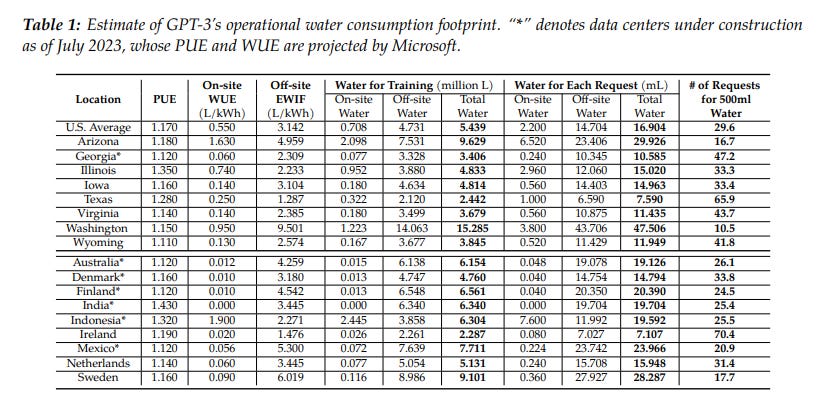
So, between the 2023 paper and the 2024 graphic, the energy-per-prompt number jumped from 4 Wh to 140 Wh. That’s a 35x increase, smuggled in with no explanation, and because both onsite cooling water and offsite generation water scale linearly with energy, the water number got dragged up roughly 30x(from 16.9ml) right along with it. This is roughly the same size of a thimble — size does matter.
Does a 30-35x jump pass a sanity check? Not really. A DGX-class server pulling around 10 kW works out to about 2.7 Wh per second, so 140 Wh implies a single prompt monopolizes an entire AI server for nearly a minute — no batching, no amortization across the hundreds of users a real deployment serves simultaneously. It’s the number you’d get if you assumed one whole server fired up at full tilt just to write your email and then sat down. GPT-4, meanwhile, is widely understood to be a mixture-of-experts model, meaning only a fraction of its parameters activate on any given prompt. Its active compute is plausibly two to five times GPT-3, not thirty-five.
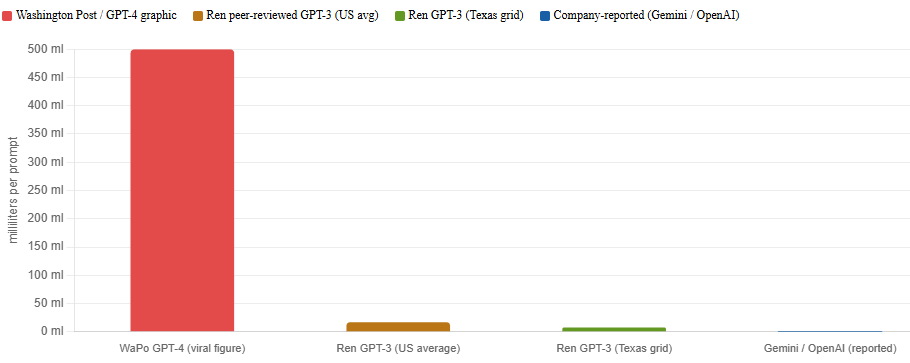
Independent analyst Andy Masley, who has spent more time autopsying this number than its authors have defending it, walks through the same arithmetic and arrives at the same place: the bottle figure is somewhere between 50 and 250 times too high, before you even account for the fact that most people who shared it assumed all that water was being poured out inside the data center, which it isn’t.

For the counter-anchors, the companies themselves now publish numbers in a completely different universe. Google’s 2025 measurement of a median Gemini text prompt came in at 0.24 Wh and 0.26 milliliters of water — about five drops. OpenAI’s Sam Altman has stated an average query runs around 0.34 Wh and 0.32 milliliters. You can be appropriately skeptical of a company grading its own homework — and you should be — but when the corporate self-estimate and the independent estimate both land within a rounding error of each other, and the viral number is sitting 1,500x above them, it’s worth asking which figure got turned into an infographic and which one got shared forty thousand times.
This is the pattern that should bother you regardless of where you sit on AI: alarming statistics get attention, corrections don’t, and the alarming version becomes common wisdom before the correction has its shoes on.
Direct, indirect, and the teaspoon-versus-bottle fight
Here’s the part nobody explains, and it’s the part that actually matters for West Texas, so stay with me.
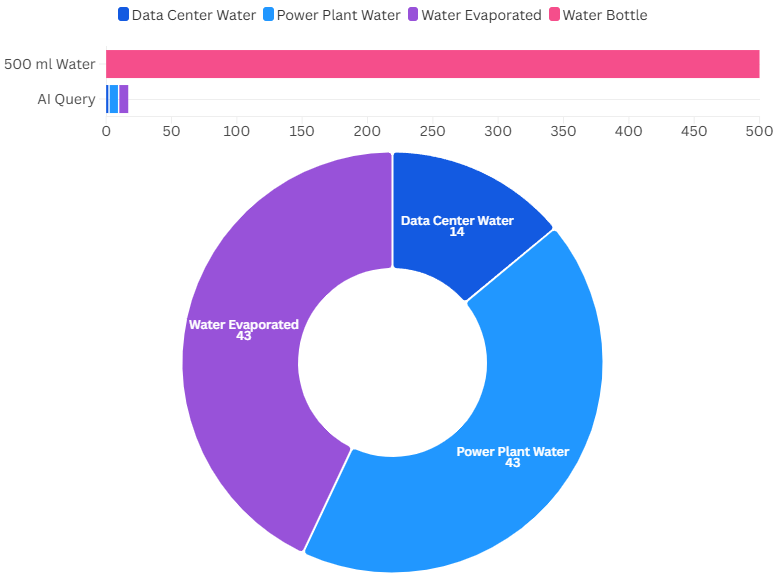
When you see ‘a teaspoon’ and ‘a whole bottle’ cited for the same prompt, neither side is necessarily lying. They’re measuring different systems. Ren’s methodology — and this is the correct, standard practice in environmental reporting — counts both the direct water evaporated onsite to cool the servers and the indirect water consumed offsite at the power plant generating the electricity. Pull the system boundary in tight around just the cooling tower and you get a teaspoon. Draw it out to include the power plant and you get the bottle.
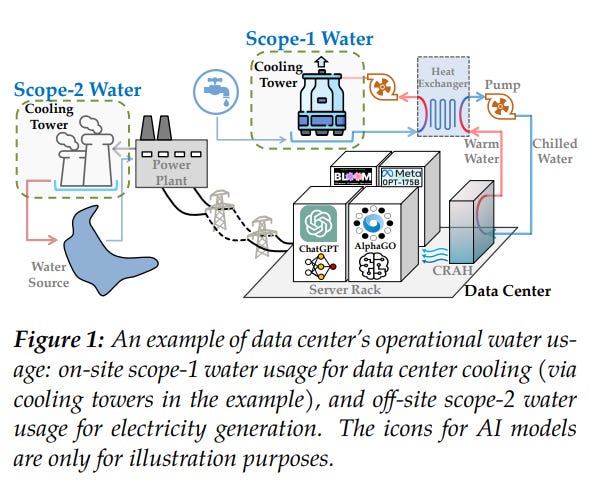
And the split is lopsided. On average, the onsite cooling water is only about a fifth of the total. Roughly 80% of the water attributed to AI is consumed not in the data center at all, but at whatever plant is making its electricity. Ren’s own paper pegs the U.S. average electricity water-consumption intensity at about 3.14 liters per kWh — water evaporated at the generation source, miles from any server.
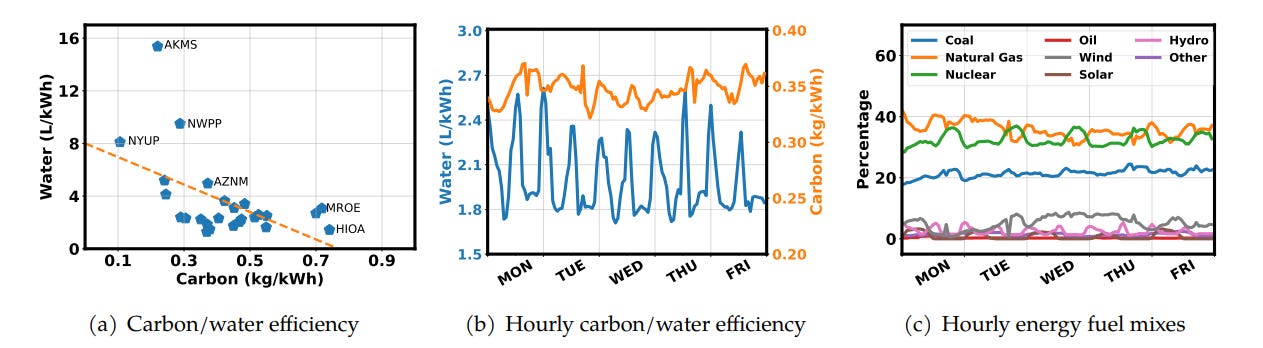
Put another way: almost all of AI’s ‘water problem’ is really an electricity-generation problem wearing a water costume. Even a digital clock has an indirect water cost — about 0.2 liters a day at the power plant — because nearly everything plugged into the grid does. The lever that actually moves AI’s water footprint isn’t banning prompts or freezing construction. It’s how and where you make the power.
A sentence you could have written about the Permian Basin in your sleep.
Everybody hates but nobody agrees on why
What’s genuinely fascinating in the social media feed is watching the left and right link arms against ‘AI data centers’ while neither side can define what a data center is, or tell AI training from cloud storage from a Bitcoin mine. We’ve written before that crypto ASICs and AI accelerators are not the same animal — one is a hammer that only sees nails, the other is general-purpose compute — but in a meme they’re the same scary warehouse.
The legitimate-concern case is real and it deserves to be taken seriously. In November, Representative Alexandria Ocasio-Cortez stood up at a House Energy and Commerce subcommittee hearing and pulled out two jars of brown, muddy water she said came from Morgan County, Georgia, next to Meta’s Stanton Springs campus. Residents there report water pressure dropping, appliances failing, and families shipping in bottled water to cook and bathe. The EPA’s assistant administrator for water, Jessica Kramer, agreed under oath to look into it. If your tap ran brown a thousand feet from a new construction site, you’d be furious too, and you’d be right to be.

But notice two things. First, causation isn’t established. As Tom’s Hardware pointed out, the turbidity may be a dropping water table pulling sediment up from the bottom of residential wells — consistent with heavy nearby water use, sure, but the Joint Development Authority admits it did no pre-construction well study, so nobody can actually draw the line yet. Second, and this is the irony worth sitting with: a good chunk of the same online crowd that spends its days insisting the government has no business telling anyone what to do is now demanding a federal moratorium on data center construction — the AOC–Sanders bill would pause it nationwide. Government overreach is tyranny until the thing being built is unpopular, at which point government can’t move fast enough. The COVID years should have taught us how quickly people will flip their entire posture on state power the moment the target changes.
Both things are true at once: real harms exist in specific places, and the national panic is running on data so thin it can’t tell a contaminated well from a server rack. That’s not a contradiction. That’s just what it looks like when bad data misdirects legitimate anger.
Smart model gets blocked: Project Jupiter
If you want the cleanest illustration of how this misfires, drive to Santa Teresa, New Mexico.
Project Jupiter is the OpenAI–Oracle data center campus under construction in Doña Ana County, part of the larger Stargate buildout, with developers talking about up to $165 billion over thirty years and a campus eventually housing hundreds of thousands of GPUs. The original plan was to power it behind the meter — its own gas turbines on a private microgrid, not drawing from the public grid or spiking residential rates. That is, more or less exactly the model we’ve advocated for West Texas: generate your own power on site, near the fuel, and leave the neighbors’ utility bills alone.
It got blocked. The New Mexico State Land Office denied five right-of-way applications tied to the gas pipeline that would feed those turbines, the Commissioner ruling it wasn’t in the interest of the state land trust. FERC staff resisted the developer’s pipeline filing over missing historic-preservation paperwork. The Environment Department racked up more than 7,000 public comments. The original design carried air permits seeking on the order of 14 million tons of greenhouse gases a year — more than Albuquerque and Las Cruces combined — so the backlash wasn’t irrational.
So in late April, Oracle pulled the gas plan and pivoted to Bloom Energy fuel cells. That cuts the projected emissions by roughly 30%, to around 10 million tons, and the campus will run closed-loop cooling. Though the fuel cells and emissions-control systems still need close to a million gallons of non-potable water a day, with the developers funding regional water infrastructure to offset it.
Hold onto the Bloom pivot, because it’s the hinge of this whole piece. The opposition didn’t kill the data center. It killed the combustion, and pushed a multibillion-dollar AI campus toward a cleaner, non-combustion, behind-the-meter generation technology. That’s not the moratorium crowd’s victory but a glimpse of the actual answer. The siting and the politics were wrong for New Mexico. They’re a lot more right two hundred miles east.
The six-mile heat rumor
The newest entry in the feed is the claim that data centers are heating the land for six miles in every direction. Unlike the bottle-of-water number, this one isn’t a meme — it comes from a real, if unfinished, piece of science, and it’s worth handling honestly.
The ‘data heat island effect’ preprint, led by a University of Cambridge team with collaborators across Singapore, France, Italy, and Hong Kong, did exactly the kind of thing you’d want done. They pulled twenty years of satellite land-surface-temperature data — NASA’s MODIS and the USGS/NASA Landsat record, 2004 to 2024 — and mapped it against more than 6,000 data centers, deliberately favoring sites away from dense cities to isolate the facilities’ signal. They report land-surface temperature rising about 2°C on average after a data center starts operating, with extreme cases near 9°C, detectable out to roughly 10 kilometers(6.2 miles) potentially touching 340 million people.
The part of the claim that’s rock solid is the instrumentation. Yes, NASA and Landsat-class satellites track surface temperature, the historical record genuinely goes back two decades, and a narrower study in Pando, Uruguay used 25 years of Landsat imagery to show a single data center throwing a heat signature visible from orbit. We’ve written before about how seriously you have to take heat and emissions accounting — methane traps far more heat per molecule than CO2 over the short term — so we’re not here to wave off thermal effects.
But two caveats matter. The paper is a preprint; it has not been peer reviewed. And the substantive pushback — again from Andy Masley, among others — is that data centers don’t get built in the middle of nowhere. They need power, fiber, and road access, and land with all three also attracts warehouses, logistics hubs, and subdivisions. Draw a 10-kilometer circle around a data center and you’re usually drawing a circle around a lot of general new construction — dark roofs, asphalt, cleared vegetation — which is the ordinary urban heat island effect that shows up wherever you build anything.
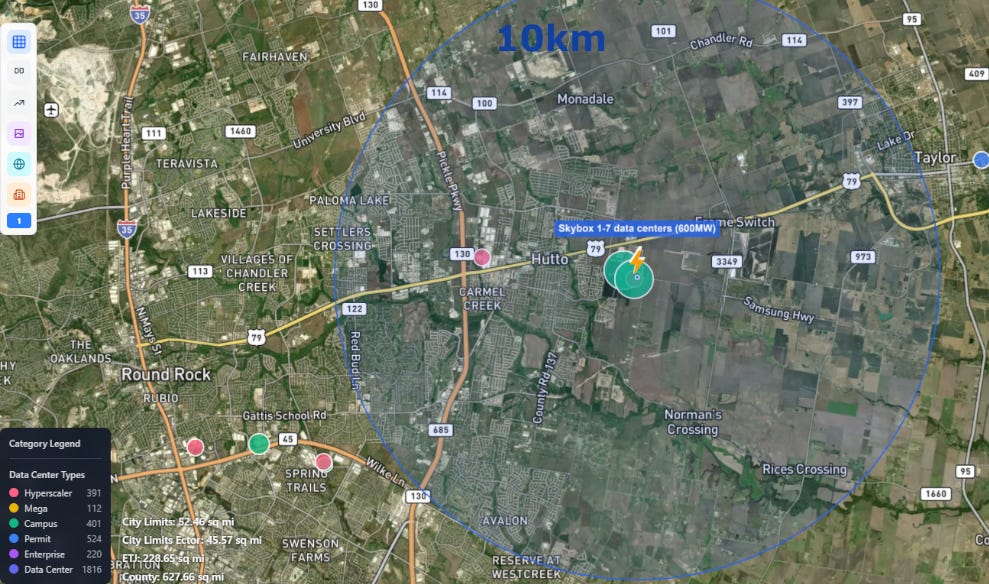
Whether the satellites are seeing server waste heat radiating six miles out or just the thermal fingerprint of developing a previously rural patch is the actual, unsettled scientific question. The satellites are real. The mechanism is contested. That distinction is the entire story, and it’s the part the screenshot leaves out.
Build where energy is abundant
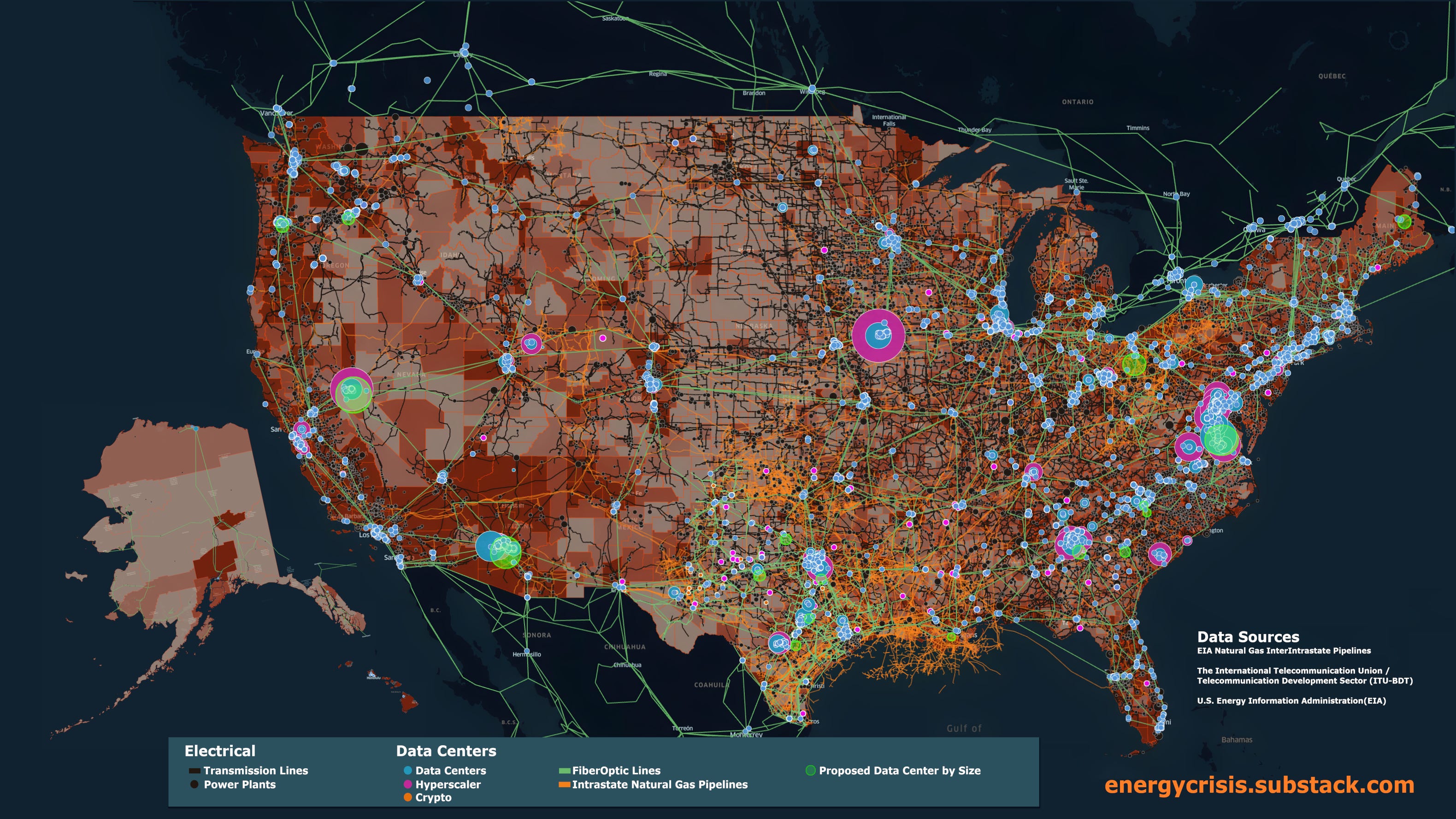
So if the real lever is where and how you make the power, and if the winning move is behind-the-meter generation sited away from people’s wells, then point at a map of the United States and ask where that describes. It describes the Permian Basin almost to the letter.
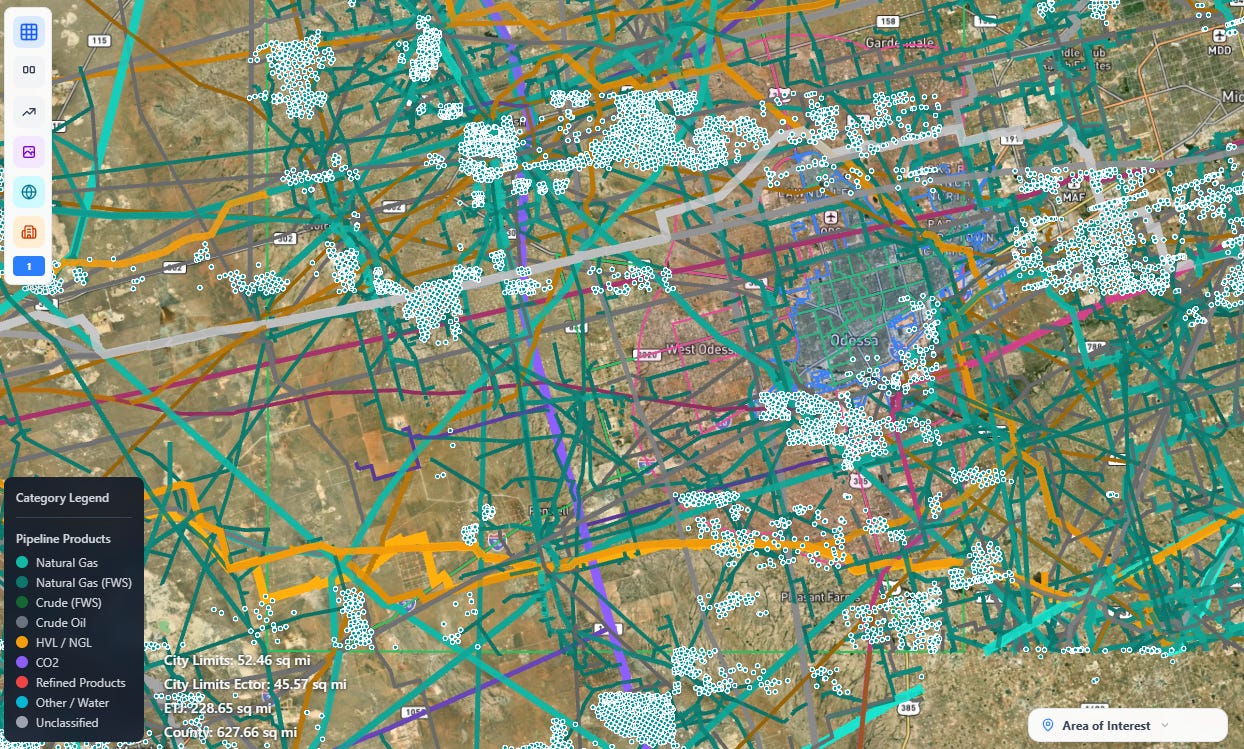
Start with the geography that the Morgan County story should make obvious. Oil and gas infrastructure is enormous and complex, but the overwhelming majority of it sits outside of town — out in the field, away from residential wells, next to the gathering systems and the power. That’s the opposite of a data center dropped a thousand feet from somebody’s back porch. A behind-the-meter facility wants to be near stranded power and cheap fuel anyway, which in West Texas means out among the pumpjacks, not in a neighborhood. The siting problem that detonated in Georgia and stalled in New Mexico is, in the Permian, mostly solved by where the infrastructure already is.
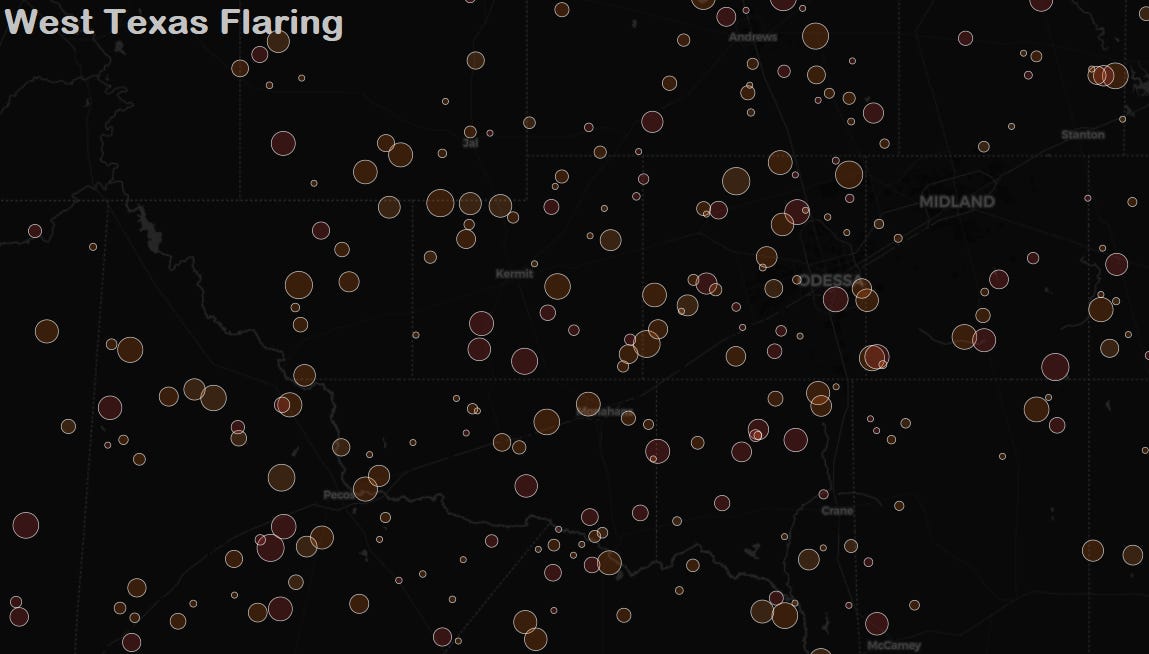
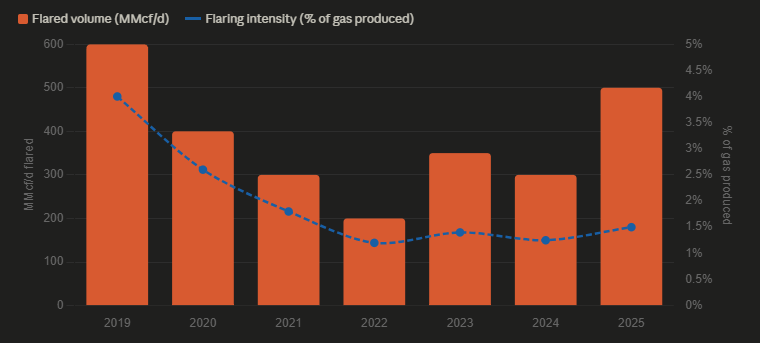
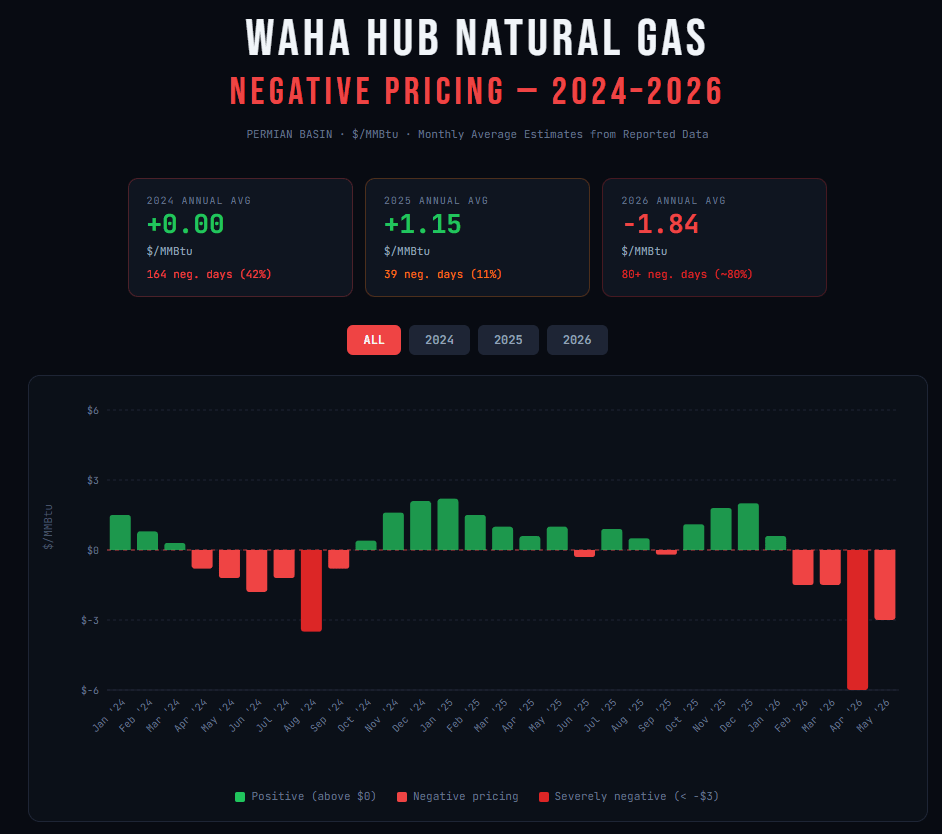
Then there’s the fuel itself. Waha hub gas has been priced into negative territory on a regular basis — producers paying to get rid of associated gas they can’t move, much of it flared off into the West Texas sky. We’ll dig into the Waha pricing mess in its own piece soon, but the one-sentence version is that the region routinely produces more gas than it can take away, and burns the surplus. A behind-the-meter data center is a demand sink that turns that flared, negatively-priced molecule into compute and revenue instead of a flare stack and a methane plume.
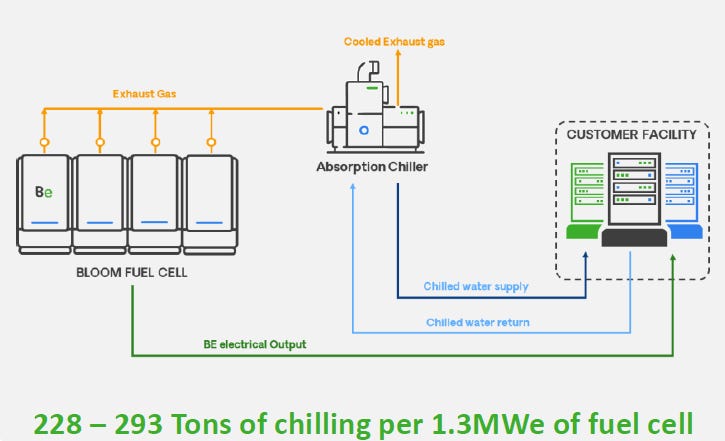
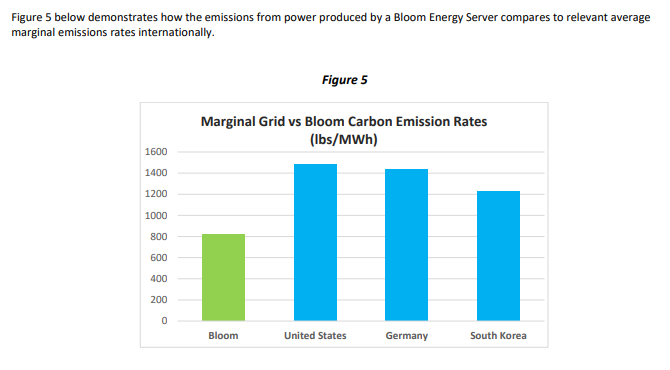
The generation technology to do it cleanly is the same one Project Jupiter just pivoted to. Bloom Energy’s solid-oxide fuel cells run on natural gas without combustion, which is why they clear emissions limits combustion turbines can’t — Bloom’s own datasheets put their CO2 rate at roughly 679–833 lbs/MWh against about 960 for a gas plant and 2,310 for coal, with NOx and SOx near zero. And here’s the part tailor-made for this application: Bloom’s Energy Server with heat capture runs hot, around 800°C, and that exhaust heat can drive absorption chillers to make chilled water for the very servers the fuel cell is powering. Run as a combined cooling, heat, and power system, Bloom claims 10–20% efficiency gains for AI data centers — you generate the power and a big chunk of the cooling from one box, on site, without waiting years for a grid interconnection.
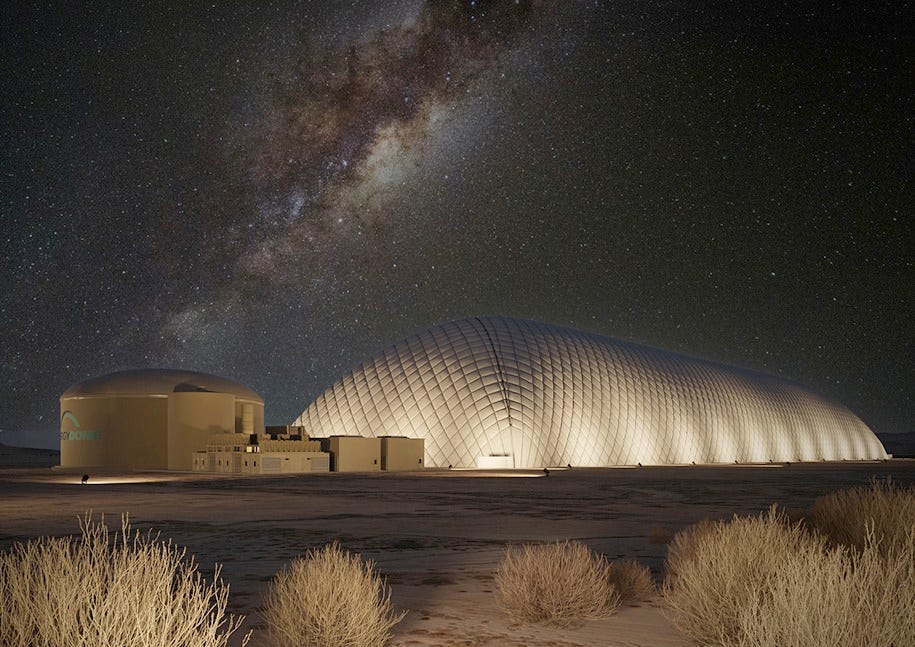
Firm it up with long-duration storage and you’ve got a self-contained plant. Energy Dome’s CO2 Battery — a closed-loop system that compresses carbon dioxide into a liquid when power is cheap and expands it back through a turbine when you need it, 8 to 24 hours of dispatch, built from steel, water, and CO2 — is exactly the kind of asset that smooths a behind-the-meter microgrid. (To be clear, it’s a storage device, not a flaring-capture scheme; the CO2 is a working fluid that never leaves the loop.) Sodium-ion batteries are coming up fast on the shorter-duration side. The point is the toolbox exists, and it doesn’t require pretending AI demand is going to politely disappear.
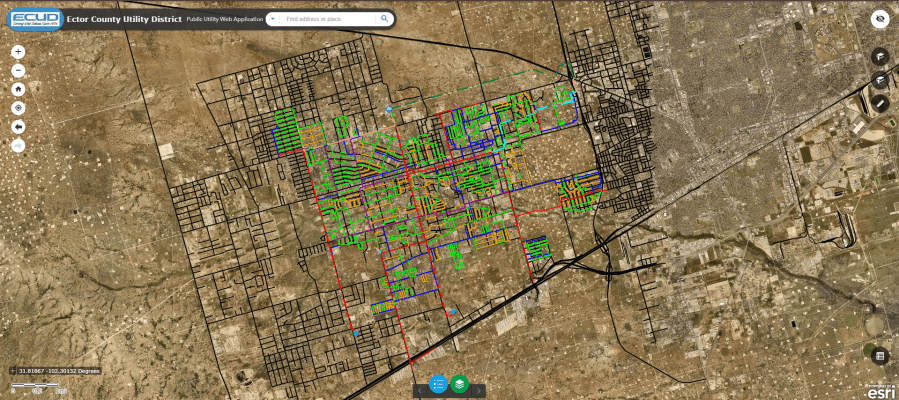
Now the water, since that’s where we started. Yes, behind-the-meter generation has a water cost — but remember the lever. The bulk of AI’s water is indirect, burned at the power plant, and when you control the generation you control that water. Build the ordinance right and you require these facilities to run on reclaimed and produced water rather than the municipal tap. West Texas is drowning in produced water and the region already runs reclamation infrastructure: Odessa’s Derrington Water Reclamation Plant processes around 7 million gallons of wastewater a day. For local scale, the City of Odessa treats up to 55 million gallons a day, and the Ector County Utility District buys roughly 63 million gallons a month(about 2 million a day) to serve more than 20,000 people out in West Odessa, a district already fighting with the city over rates and already stretched.
Drop an unregulated potable-water hog into that and you’ve recreated Morgan County. Require produced-water recycling and tie it to the cheapest stranded energy in North America, and water becomes a small, manageable line item, because the enormous energy savings carry the project. A large project for Ector County that is no longer in play was never scrutinized for the amount of water it would have required because the term AI was not attached to it. Nacero’s planned Penwell plant, for reference, is engineered to need 8.7 million gallons a day at full buildout — these are real volumes, and they have to be planned for, not waved away or panicked over. This same area near Penwell is one of the most prominent areas for these facilities since its located near a major city that has workforce feeders, natural gas infrastructure, CO2 takeaway, renewables through solar, and vast amounts of flat desert surface with extremely low population.
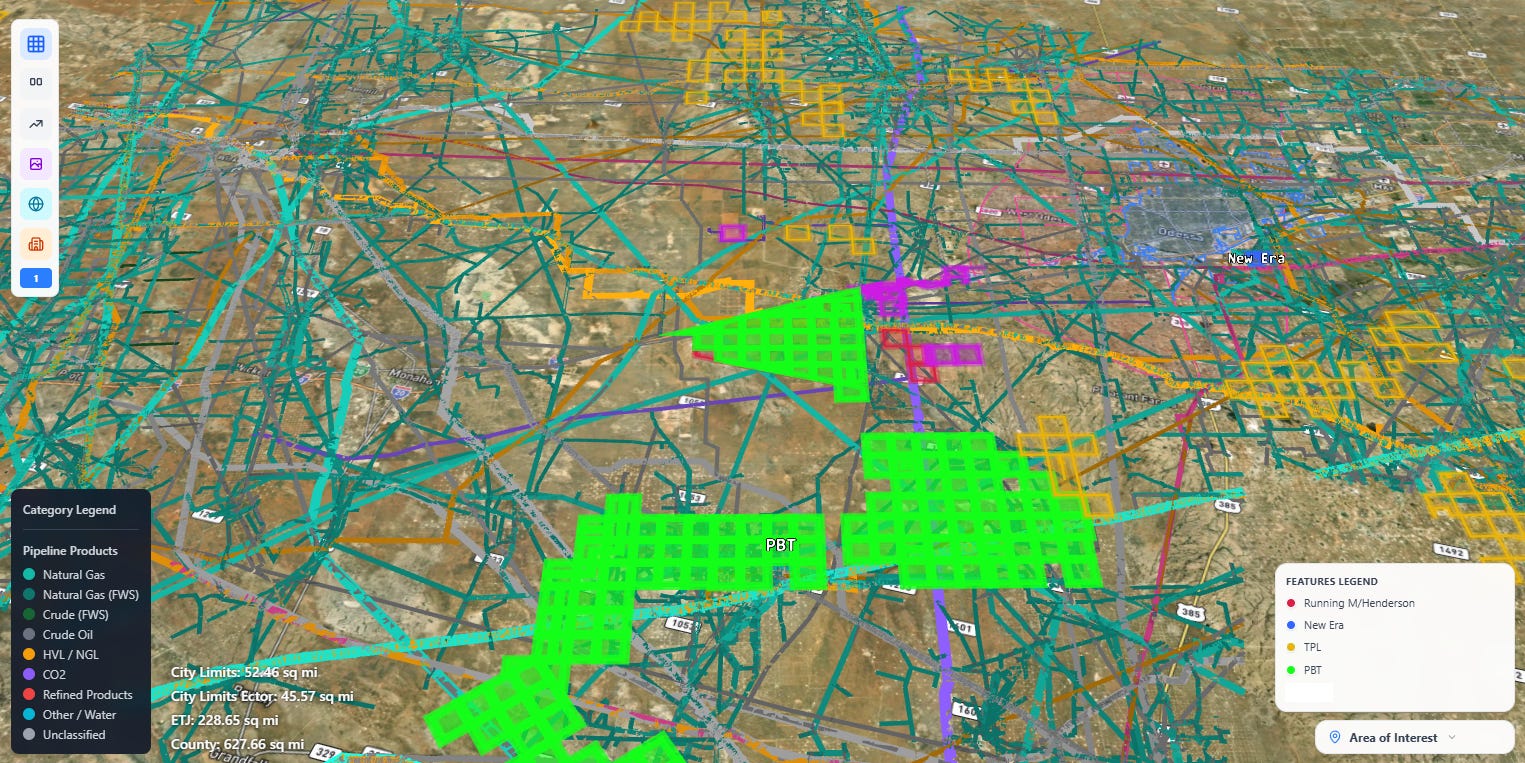
Careful planning and execution is the whole game. Not every project is the same. A campus that drains a rural aquifer through the municipal system deserves the protest it gets. A campus that sits on produced-water recycling, burns stranded gas through non-combustion fuel cells out where the infrastructure already lives, and never touches the neighbors’ wells is a different animal entirely — and the meme can’t tell them apart.
The part the doomers get backwards
There’s a parallel worth closing on. In Adam Fergusson’s When Money Dies, his account of Weimar Germany’s hyperinflation, one of the quieter lessons is what held value when the currency didn’t. The theoretical, the philosophical, the abstract professions got hollowed out. The trades — the people who could actually build, wire, weld, and fix a tangible thing — were still needed, because the physical world still had to be assembled regardless of what the mark was doing that afternoon.
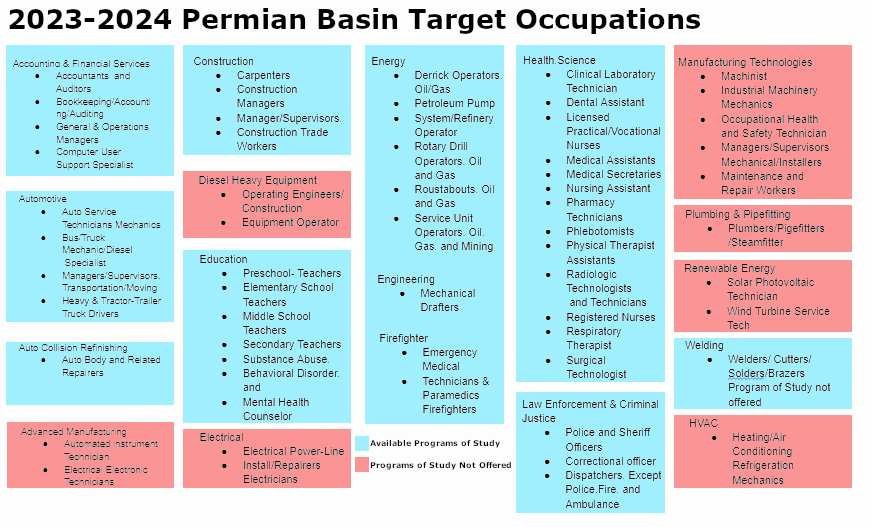
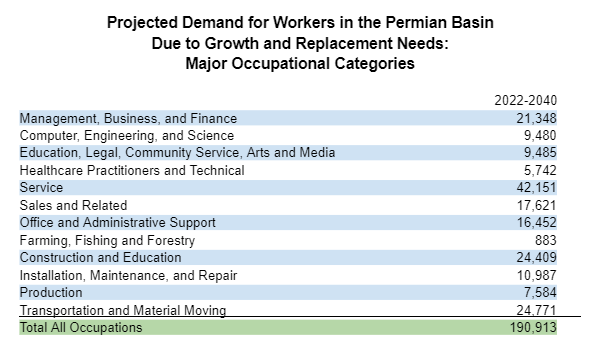
The dystopian tech gurus will tell you AI is coming for every job, and the anti-AI crowd will tell you the data centers bring nothing but a few security guards and a drained reservoir. Both are working from the same shortsighted place. A data center buildout is miles of fiber, miles of electrical, acres of HVAC, and a small army of construction, instrumentation, and maintenance workers; exactly the skilled trades the Permian is already racing to train before the projected 190,913-worker shortfall by 2040 swallows the region. Project Jupiter alone is talking thousands of construction jobs and 1,500 permanent roles. The physical economy doesn’t evaporate because the software got smarter. It gets bigger, and it gets built by people who know which end of a conduit bender to hold.
We’ve said it since Hunger of AI and we’ll say it again: demand is understated, energy is additive rather than substitutive, no civilization in history has ever reduced its reliance on a single energy source so much as stacked new ones on top, and the loudest voice in the room — this time holding up an AI-generated meme about a bottle of water — is almost always the one working from the worst data.
The crisis was never that AI drinks too much. It’s that we keep letting the thirstiest take on the facts go viral that just ain’t so.