Networking the Permian

‘Just as electricity transformed almost everything 100 years ago, today I actually have a hard time thinking of an industry that I don’t think AI will transform in the next several years.’ - Andrew Ng
The shale revolution and the Permian Basin specifically have opened up a vast landscape of opportunities for the United States to harness by providing some of the cleanest and cheap energy in the world off of associated petroleum gas from wells targeted at producing oil. According to the Energy Information Administration(EIA) ‘A growing share of U.S. natural gas production is associated-dissolved natural gas (natural gas produced from oil wells), which is the result of increased crude oil production from low permeability, tight rock formations—Permian, Bakken, Eagle Ford, Niobrara, and Anadarko. In 2018, associated-dissolved natural gas production in these five major crude oil-producing regions was 12.0 billion cubic feet per day (Bcf/d), or about 37% of total natural gas production in these regions and about 12% of total U.S. natural gas production.’
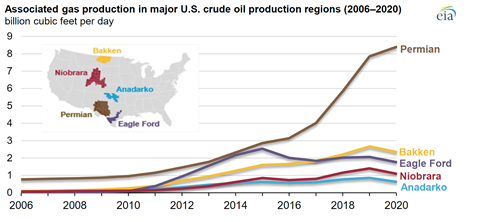
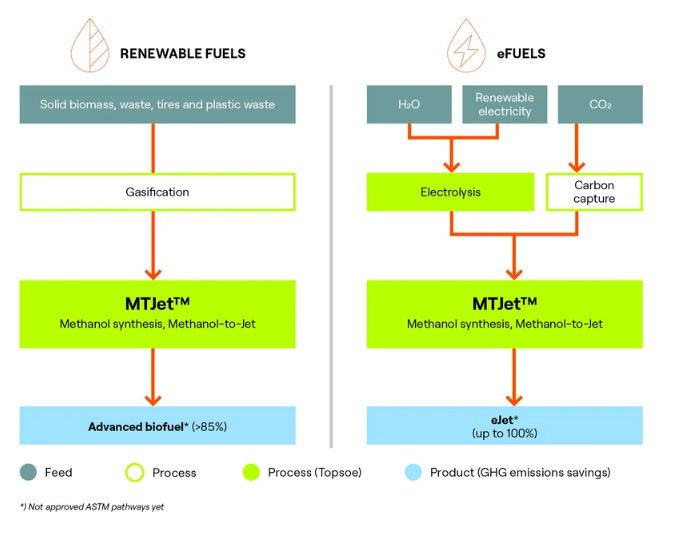
The Permian gas production has been a problem for some operators needing to move volumes which tend to get lower rates than are desirable. New ventures such as a partnership with Verde and Diamondback to build natural gas-to-gasoline facilities in the Permian Basin utilizing excess gas that would normally be flared off are starting to take shape. A project in Ector County under Nacero that was profiled on Energy Crisis had an original project plan was to develop clean burning gasoline fuel similar to the Verde/Diamondback deal from natural gas feedstock but has shifted its plans to produce sustainable aviation fuels(SAF) while still in pre construction planning for the facility. Using captured biogas feedstock, integrated carbon capture, and 100% renewable power will result in millions of tons of CO2 savings annually while creating thousands of clean energy jobs and adding a forecast $20 billion to the regional economy.
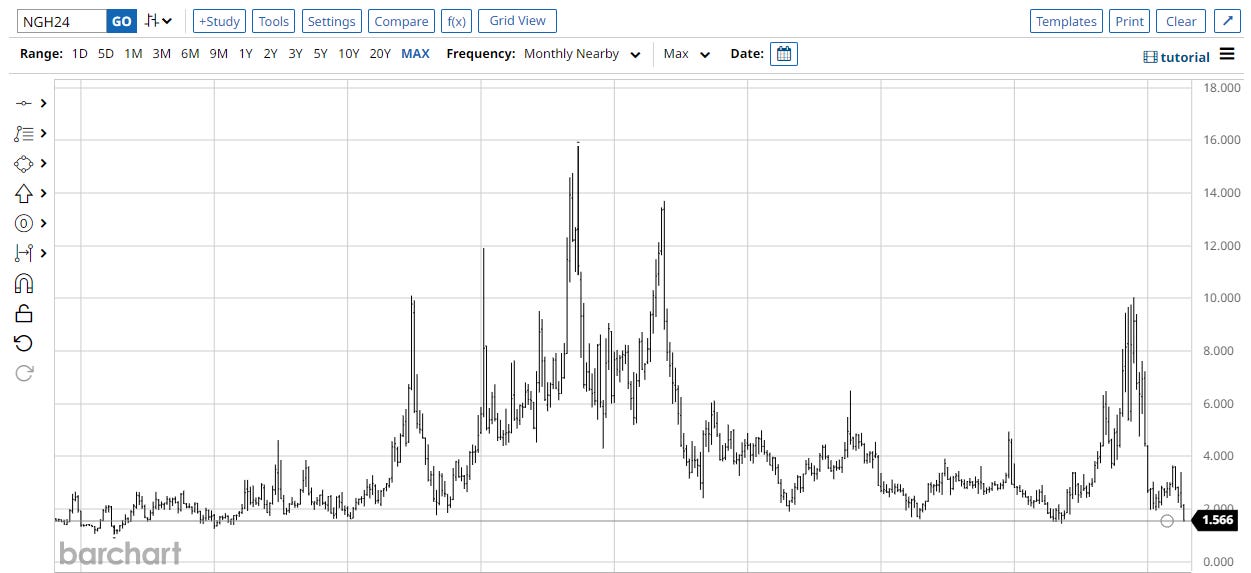
Natural Gas prices have plummeted in recent months as warmer than expected weather and a continued increase in supply has continued to push inventories up. The price is now at a 25 year low marking a dip that predates the shale fracing revolution that helped unlock affordable and abundant energy for the U.S. to leverage its economy on. Outside of the crash in prices during lockdowns from COVID these prices seemed unfathomable in recent years but now have producers questioning what to do with this excess gas.
Some startups have turned to natural gas in recent years to leverage the excess being flared and harness its energy as a way to produce speculative assets that many believe will hold a value in the future well beyond the cost to maintain equipment, generators, personnel, and other cost inputs through mining of cryptocurrencies and in most cases specifically Bitcoin mining. This type of mining utilizes an application-specific integrated circuit (ASIC) which is an integrated circuit chip designed for a specific purpose and generally designed only to mine a certain digital currency. While the development of these mining rigs is costly and complex they cannot be utilized for other processes and have high heat exchange, are power hungry, and require hardware replacement to stay competitive. Much like a toolbox with only a hammer, Bitcoin miners enthusiasm becomes fixated where everything starts to look like a nail(Bitcoin) and solutions are postulated for problems that never existed in the first place.
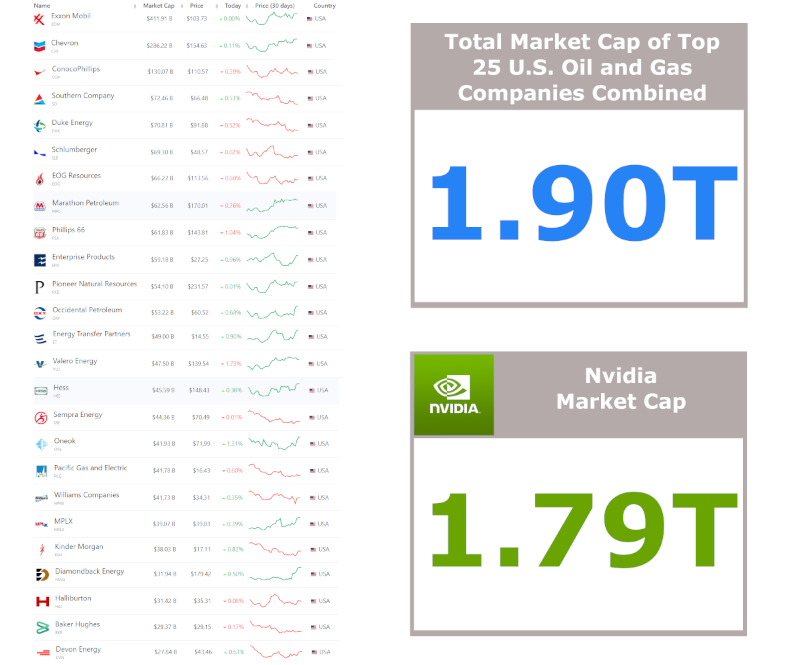
While Bitcoin has lost some favor in recent years through the bull and bust cycle that resembles an unhinged natural gas market at times, the emergence of artificial intelligence(AI) through companies like Nvidia(NVDA) have gained markets attention on how high the celling can be for sales and revenue. Unlike mining for cryptocurrencies the hardware used by companies like Nvidia are not tied to a specific task and offer seemingly unlimited possibilities for processing data. To put into perspective how much the public markets currently believe in the future of AI, Nvidia alone now has a market cap comparable to the top 25 U.S. Oil and Gas companies combined.
The focus of growth according to Nvidia is on the Hopper-based HGX platform that has increased the data center revenue by 171% and compute growth by 195% which is mostly used for large language models(LLM) and generative AI or basically platforms like ChatGPT that spit out human readable interpretations of data that read more like a story. An estimated 6.3B of the total revenue for the first quarter came from the sale of HGX components that go into the DGX servers translating into 36,600 machines and around 293,600 GPUs. Nvidia shows specs of 10.2KW as the max consumption of the DGX H100 which is about 1.6x higher than the DGX A100. This is on account of the higher thermal envelope for the H100, which draws up to 700 watts compared to the A100’s 400 watts. Though power consumption is not linear at scale when calculating the throughput of these platforms it is also safe to assume that a large portion of these cards will not be sitting idle in the data center. According to Bloomberg New Energy Outlook (NEO) the energy transition scenario requires 46,000 terawatt-hours of power generation in 2050, nearly double today’s amount. The Net Zero Scenario, however, requires more than 80,000 terawatt-hours of generation, more than triple today’s amount.

Recently, a non-profit was formed with the intention of bringing new infrastructure to the Permian Basin in the form of high speed broadband at gigabit speeds versus the current 50-100 Mbit options in the majority of the region across all of Ector County with a mixture of fiber, mesh WIFI, point-to-point, and small cell 5G. With all the technologies available in the Permian for Oil and Gas the average residential and commercial facility in many parts of the region are tethered to sub par access of broadband options. While the demand of datacenters power consumption grows an opportunity to capture the power of excess gas that normally would be flared off could shift away from ideas of cryptocurrency and into modular raw processing power fed in remote locations where the largest current bottle neck is no longer energy but access to large data throughput on the network. A need that this new non-profit initiative could meet with the right partnerships and grants to create an energy and data dense Permian Basin.
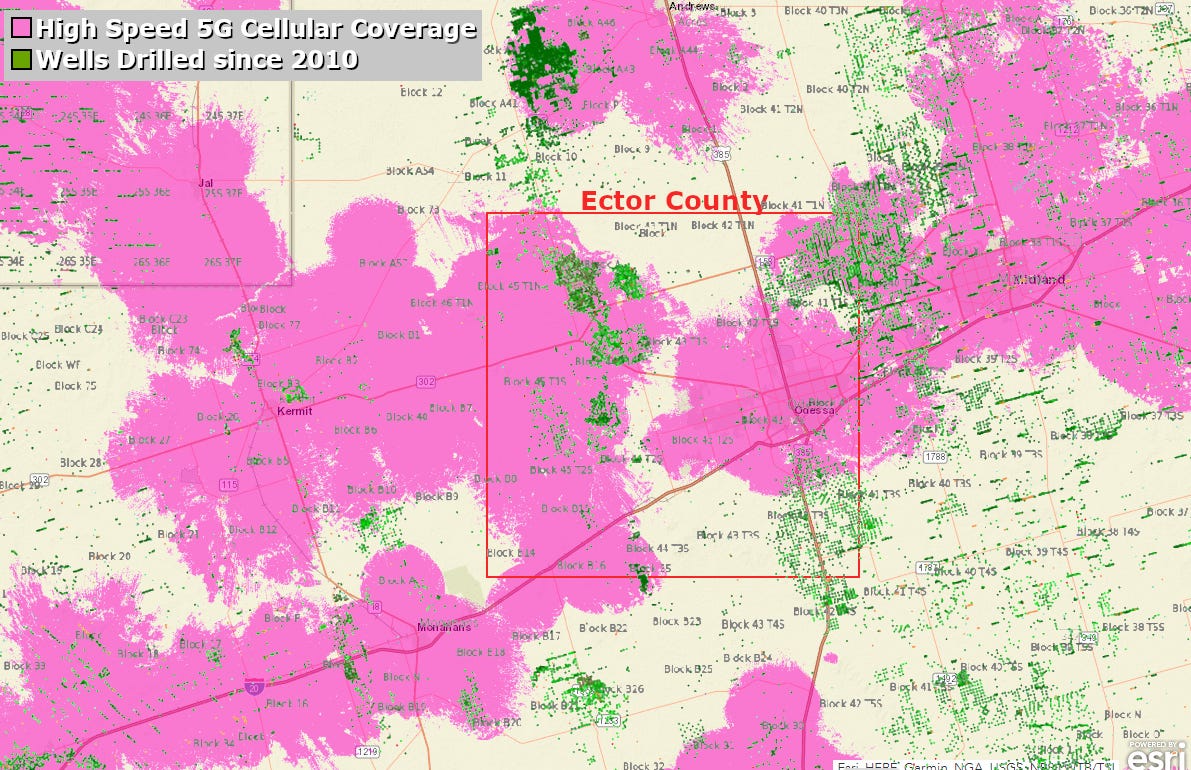
The Internet of Things(IoT) has brought connectivity and efficiency to the industry through fleet/asset tracking, remote monitoring of storage and equipment, smart metering, and many other insights into process optimization and process controls. This has allowed the industry to shift focus and resources by becoming more robust, safe and in almost every way extremely efficient through cost saving measures. However, without the connection to the network these devices would be useless and because of the rural and remote placement of most oil and gas structures a connection to a reliable network is often created locally across large spaces by the operator through mesh short and long range technologies to later connect to the broader internet since even cellular coverage is unavailable in many areas.
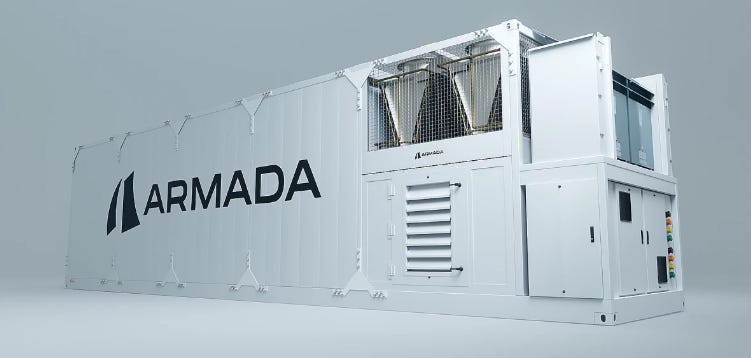
An edge network is a data architecture strategically organized to provision compute to the edge devices within a network, offsetting processing power requirements from the main servers by allowing the devices to do a majority of the processing work. Startups such as Armada have already emerged in the space of remote edge computing utilizing ISO 20-40 foot storage containers, Starlink satellite internet, and off grid power generation through natural gas to deploy mobile edge datacenters anywhere.
Another startup Crusoe also uses flare mitigation data centers with security access controls, dust-proof vestibules, redundant HVAC cooling, and fire suppression systems. Customers pay for power at flat monthly rates, and can have a power at 12.5kW-25kW per rack, or 250kW per module with offerings ranging from the Nvidia A40 to the H100 Tensor Core GPU with on-demand pricing ranging from $1.10 to +$2 depending on the GPU compute power selected.
Artificial Intelligence has made its way into many aspects of the energy sector with deep learning models interpreting seismic, predicting mechanical failures, suggestion to process workflow, dispatch routing, and much more. Though many tasks cannot be replaced with AI in an industrial world that requires large heavy equipment movement and maintenance with a growing workforce projected to increase by 190k by 2040, the efficiency gains and decrease in error/failure rates can move margins at scale for these Oil and Gas companies and why all the major producers have been investing in AI technologies for decades. As the Permian Basin looks for ways to harness the abundance of natural gas as a feedstock into different ventures and the impact a fully connected Ector and surrounding counties can have backed by true large scale broadband everywhere; the emergence of remote datacenters will begin to create sustainable capital and investment in an area best equipped with meeting the demands of that power consumption of very hungry AI world.